Cervical spondylosis is a common starting point for chronic neck pain, stiffness, and hampered movement. This is predominantly seen in adults who have a sedentary lifestyle and spend majority of the time sitting, working online, or having a continued poor posture. But, the good news is that well-planned cervical spondylosis exercises, paired with by proper physiotherapy, can remarkably help in lessening the pain, rebuilding functionality and having a better quality of life.
This blog is designed to help you understand exactly what cervical spondylosis is, why pain occurs and how the right exercise for cervical spondylosis becomes a life-saver for sustainably and effectively managing it.
If your neck feels stiff and heavy or aches upon waking and remains sore after a long day, you are not alone and this guide is meant for you.
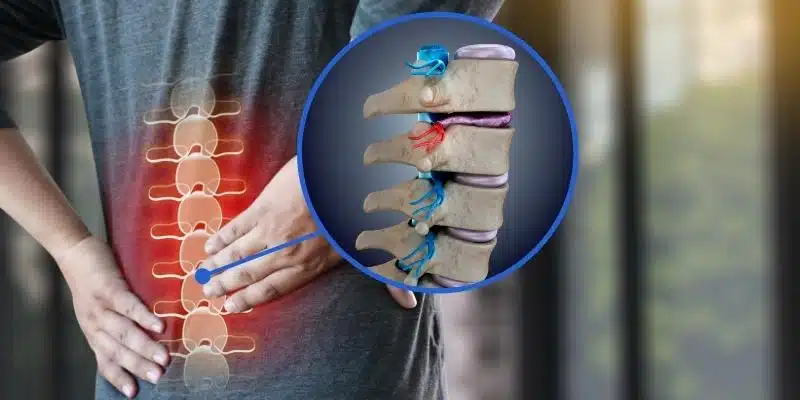
A lot of people search for what is cervical spondylosis because the term sounds alarming. In simple words, cervical spondylosis refers to age-related or wear-and-tear changes in the cervical spine, which is the portion of the spine located in your neck.
These changes may include
Usually, it’s found to occur with aging, but, cervical spondylosis can occur even in younger adults specifically those who have a sedentary lifestyle or long-term mobile/laptop use, or chronic stress-related muscle tension
Symptoms vary depending on severity. Many people with mild cervical spondylosis may have no symptoms at all, while others experience daily discomfort.
Common cervical spondylosis symptoms include
For more advanced cases like cervical spondylosis with radiculopathy, the symptoms may include:
It is at this stage that cervical spondylosis treatment becomes a requirement.
Degeneration alone is not the source of pain. The pain also originates from a combination of
This explains why rest alone rarely solves the problem. That is why exercise for cervical spondylosis plays such a critical role in recovery.
This is a very common search query: how to cure cervical spondylosis permanently.
The honest and scientific answer is that cervical spondylosis cannot be completely reversed, due to the degenerative changes being structural. However, it can be effectively regulated and managed to make the pain minimal or completely absent. The treatment would empower the person to person all their daily tasks comfortably without any discomfort.
Moreover, the treatment can also make the progression slower.
Consistent cervical spondylosis exercises, posture correction, and well-planned physiotherapy for cervical spondylosis are the most effective solutions for the issue.
Before starting with any cervical spondylosis exercises, one must carefully evaluate if these exercises are suitable for your current condition or not. When your physical and mental fitness qualify you for doing it, it can result in significant reduction in pain. However, if done without proper awareness, it can in fact worsen the pain.
These exercises are generally fine for:
Individuals who have been qualified by a healthcare professional
Individuals with the following should either refrain from or take a lot of care and professional guidance before indulging in these exercises
In cases such as there, a well-tailored personalized physiotherapy for cervical spondylosis is recommended before trying any exercise at home.
Understanding the difference between safe discomfort and warning signs helps build more awareness.
Normal responses may include:
Warning signs that require stopping exercises:
If you feel any of these happening to you, its advisable to stop the exercises immediately and get some professional advice.
Also Read: Physiotherapy For Back Pain ; Physiotherapy For Knee Pain
Physiotherapy for cervical spondylosis is a sustained process. Instead of helping the client get temporary relief, the aim here is for long-term recovery.
A physiotherapy program with a definite yet flexible structure helps:
While painkillers only help in relieving the surface level symptoms by suppressing them, physiotherapy looks into the underlying causes of pain. The more consistent is the guidance and physiotherapy, the better are the movements, wellbeing and functioning.
Also Read: Physiotherapy For Joint Pain ; Physiotherapy For Disc Burge
This curated list of cervical spondylosis exercises is your guide to improve neck movements, reduce muscle stiffness, bolster spine alignment. It will also help you to build back the strength in your cervical joints with slow, consistent practice without any strain or burden on the joints.
Improving the movement in the sagittal plane, this exercise helps to deal with stiffness due to constant sitting, screen use, and forward head posture. All these lifestyle patterns are common contributors to cervical spondylosis.
How to do it:
Sit or stand with your spine upright. Let your shoulders be relaxed. Slowly bend your head forward, bringing your chin toward your chest. Keep doing until you feel a gentle stretch at the back of your neck. Hold this position briefly, then return to neutral. From there, gently take your head backward, looking upward without compressing the neck.
Breathing cue:
Exhale as you move the neck and inhale as you return to neutral.
Repetitions:
8–10 repetitions, 1–2 sets.
Why it helps:
Maintains neck joint mobility, reduces stiffness, and improves circulation to cervical tissues.
Like we did for the first exercise, this one aims to do just that but sideways. Side bending targets the stiff lateral neck muscles (such as the upper trapezius and scalenes). These muscles are responsible for headaches, shoulder pain, and stiffness.
How to do it:
From a neutral position, slowly tilt your head toward one shoulder. Try to bring your ear as close to the shoulder as you can but at a slow comfortable pace. Keep your face forward and avoid rotating the head. Hold the stretch gently, then return to centre and repeat on the other side.
Key tip:
Your shoulders should remain relaxed and at a uniform level throughout this exercise.
Repetitions:
6–8 repetitions per side.
Why it helps:
Reduces muscle imbalance and eases tension-related neck pain.
Neck rotation is crucial in helping to restore functional movement needed for daily activities such as driving, looking over the shoulder, or changing positions during sleep. Like the above exercises, this one aims to move the neck right and left.
How to do it:
Sit straight and slowly turn your head to one side, keeping your chin level and movement smooth. Stop at the first point of resistance or mild stretch, then return to centre and repeat on the opposite side.
Progression note:
If you have multilevel cervical spondylosis, move with caution. Work with a smaller, comfortable range and avoid forcing the motion.
Repetitions:
6–10 repetitions per side.
Why it helps:
Prevents joint stiffness and maintains functional range of motion.
One of the most recommended and reliable exercises which is well-research too is that of Chin tucks. Its a very important cervical spondylosis exercises, specifically for people with forward head posture or people who use their phones frequently.
How to do it:
Sit or stand with your back upright. Gently draw your chin backward (as if making a double chin), keeping your head level and eyes facing forward. Hold for a few seconds, then relax.
Important:
This exercise pushes the neck into a backward glide, its not a downward nod. So be careful about the direction of the movement.
Repetitions:
8–12 repetitions, 2–3 sets.
Why it helps:
Helps build deep neck flexor muscles, lessens the strain on cervical joints, and improves posture over time.
Isometric exercises are simple exercises with huge benefits especially feasible for mild cervical spondylosis. They strengthen the neck muscles and don’t require any movement and if perfect for early rehabilitation.
How to do it:
Place your palm on your forehead and gently press your head into your hand without allowing movement. Hold, then relax. Repeat the same technique by placing your hand at the back of your head and on each side.
Hold time:
5–7 seconds per direction.
Repetitions:
5 repetitions in each direction.
Why it helps:
Builds muscular endurance and joint stability while minimizing stress on the spine.
Shoulder Rolls are generally effective for neck pains and starts from postural misalignments. Poor shoulders and upper-back mechanics is the main reason for it. This exercise addresses to better the coordination between the neck and shoulder girdle.
How to do it:
Lift your shoulders upward, roll them backward, and gently lower them down in a circular motion. After several repetitions, reverse the direction. You can also practice squeezing your shoulder blades together gently and holding and then relaxing.
Repetitions:
10–12 rolls in each direction.
Why it helps:
Improves upper-back support, reduces neck muscle overload, and promotes better posture.
People experiencing tension headaches, stress-related neck pain, any kind of stiffness post the working hours can benefit incredibly from this movement. Done consistently, it slowly repairs the ares of strain and promotes wellbeing.
How to do it:
Sit upright and tilt your head slightly forward and to one side, as if looking toward your armpit. You should feel a stretch along the back and side of the neck. Hold gently, then switch sides.
Hold time:
15–20 seconds.
Repetitions:
2–3 times per side.
Why it helps:
Relieves muscle tightness, improves blood flow, and reduces headache frequency.
These cervical spondylosis exercises will only show results when done steadily, regularly, combined with lifestyle changes like posture correction, mindfulness and professional guidance. If pain increases, spreads to the arms, or occurrences of numbness or weakness, its highly preferable to consult a qualified physiotherapist before resuming.

| Level | Exercises Included | Frequency | Key Notes |
|---|---|---|---|
| Beginner | Neck flexion and extension, side neck bending, neck rotation, basic chin tucks, shoulder rolls | Daily | Move slowly, pain free range only. Ideal for stiffness, early symptoms, or first time exercise starters. |
| Moderate Pain | Chin tucks, isometric neck strengthening, controlled neck rotations, side bending, scapular control exercises | 5 days per week | Focus on controlled movements and breathing. Stop if pain travels to arms or causes dizziness. |
| Maintenance | Isometric neck exercises, chin tucks, shoulder blade strengthening, upper trapezius and levator stretches | 3–4 days per week | Best for long term neck health and preventing recurrence once pain is under control. |
While cervical spondylosis exercises are the primary way through the pain, forming the backbone of recovery, a more comprehensive treatment plan can adapt to people of different needs. Effective cervical spondylosis treatment almost always is efficacious when combined with other supportive treatments simultaneously. This eclectic approach provides a more integrated and holistic healing. Thus, quickly reducing pain, avoiding recurrence, and improving long-term neck health.
A well-rounded treatment plan may include:
Amongst so many occurrences of cervical spondylosis, the majority cases do not require surgery and can be managed conservatively through mobility and lifestyle corrections. Only when severe neurological compromise is present (such as progressive weakness or spinal cord compression) the non-surgical methods are not very sufficient.
Living with cervical spondylosis does not have to mean that you are in constant discomfort. Seeking help, maintaining healthy lifestyle, doing the right exercise for cervical spondylosis, guided by physiotherapy for cervical spondylosis, a lot of people see major improvements in having a conformable and controlled life again.
Consult a physiotherapist if pain persists, worsens, or spreads to the arms.
Chin tuck exercises are the best for cervical spondylosis as they correct forward head posture, improve neck alignment, reduce cervical joint stress/stiffness, and relieve chronic neck pain effectively.
Physiotherapy for cervical spondylosis usually shows improvement within 4 to 8 weeks with regular sessions, posture correction, and consistent home exercise practice.
Cervical spondylosis is usually mild and manageable. Serious complications are rare when symptoms are addressed early with physiotherapy and lifestyle modifications.
Cervical spondylosis is not completely curable, but symptoms can be well controlled long-term with physiotherapy, exercises, posture correction, and ergonomic care.
Common causes of cervical spondylosis include age-related degeneration, poor posture, prolonged screen use, repetitive neck strain, weak neck muscles, and spinal disc dehydration.
The best treatment for cervical spondylosis combines physiotherapy, posture correction, ergonomic changes, stress management, and targeted exercises rather than relying only on painkillers.
Dr. Nidhi Kumari
She has persuaded her bachelor’s from SGT University, Gurugram, she has done her internship at Dr. Ram Manohar Lohia Hospital, and persuade her Master in Physiotherapy from Chaudhary Charan Singh University, Meerut. She has previously worked with Orthocure clinic, Dr.Nasir physiotherapy rehabilitation, Quantum physiotherapy, and wellness center.
If you have more questions.
Dr. Nidhi
She has persuaded her bachelor’s from SGT University, Gurugram, she has done her internship at Dr. Ram Manohar Lohia Hospital, and persuade her Master in Physiotherapy from Chaudhary Charan Singh University, Meerut. She has previously worked with Orthocure clinic, Dr.Nasir physiotherapy rehabilitation, Quantum physiotherapy, and wellness center.
If you have more questions.
Also Read: Back Pain: Causes and Treatment
If you would like to know more about any of the health conditions, please fill up the form below and talk to Doctors on Resolve360 directly by asking a question.
We are your doctor’s first choice and trusted by 50,000+ patients.
Resolve360 is great platform for online physiotherapy.
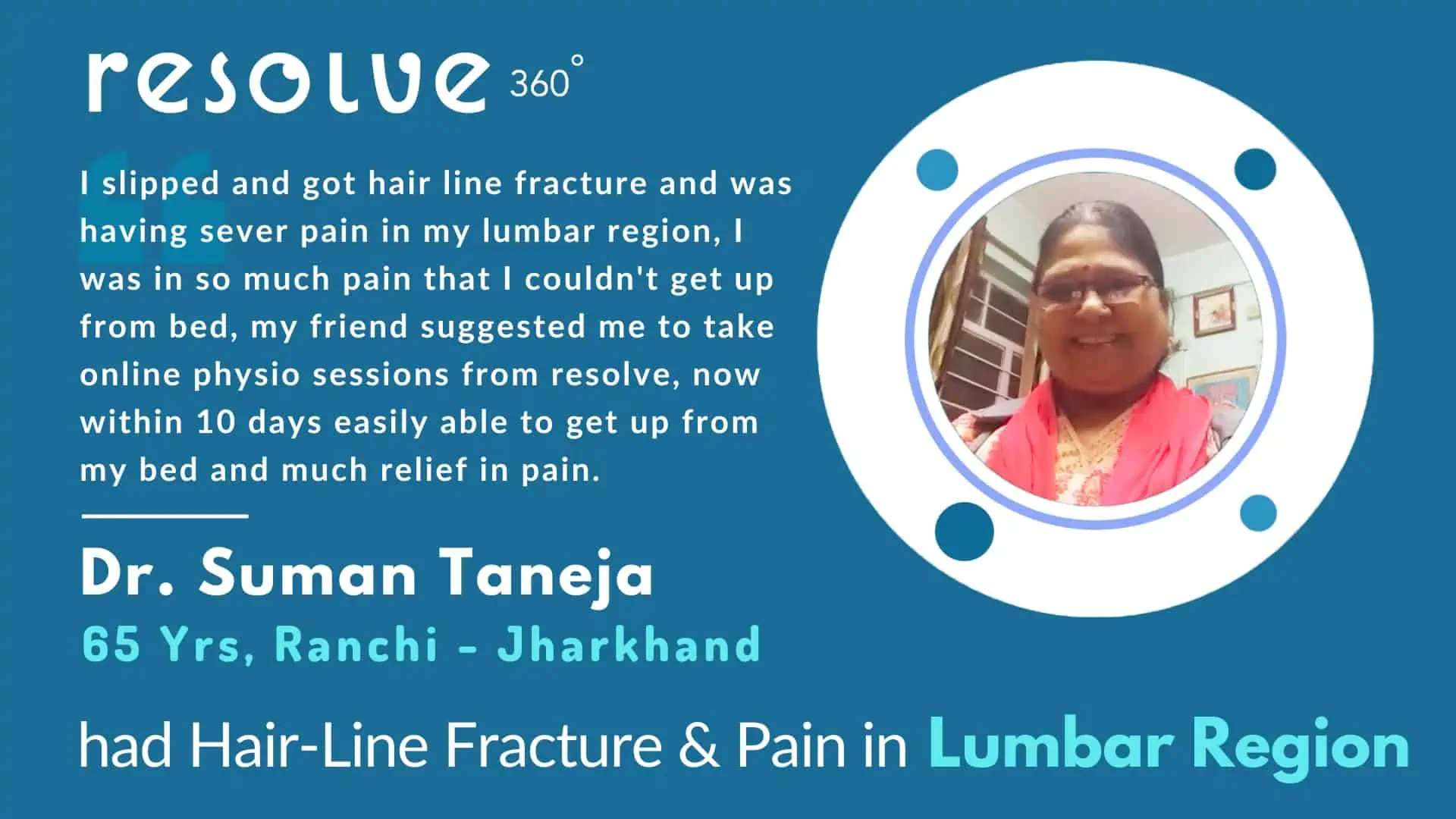
I was suffering from scapula dyskinesia and had lot of pain in right shoulder movement. I was introduced to Resolve 360 by my oncologist.
Within a month (26 sessions) there was a considerable improvement. Sessions are very cost-effective and doctors are very kind and efficient.
Doctor David has been really great and helpful. I would highly recommend Resolve 360.
I took prenatal care program from Resolve 360. Dr. Preyrna was assigned to me and she has done commendable job. I did prenatal exercises under her supervision, she designed program according to my body need. With her help my pregnancy was healthy and I got good dilations at the time of delivery. I am blessed with a healthy baby girl and very happy with Resolve 360.
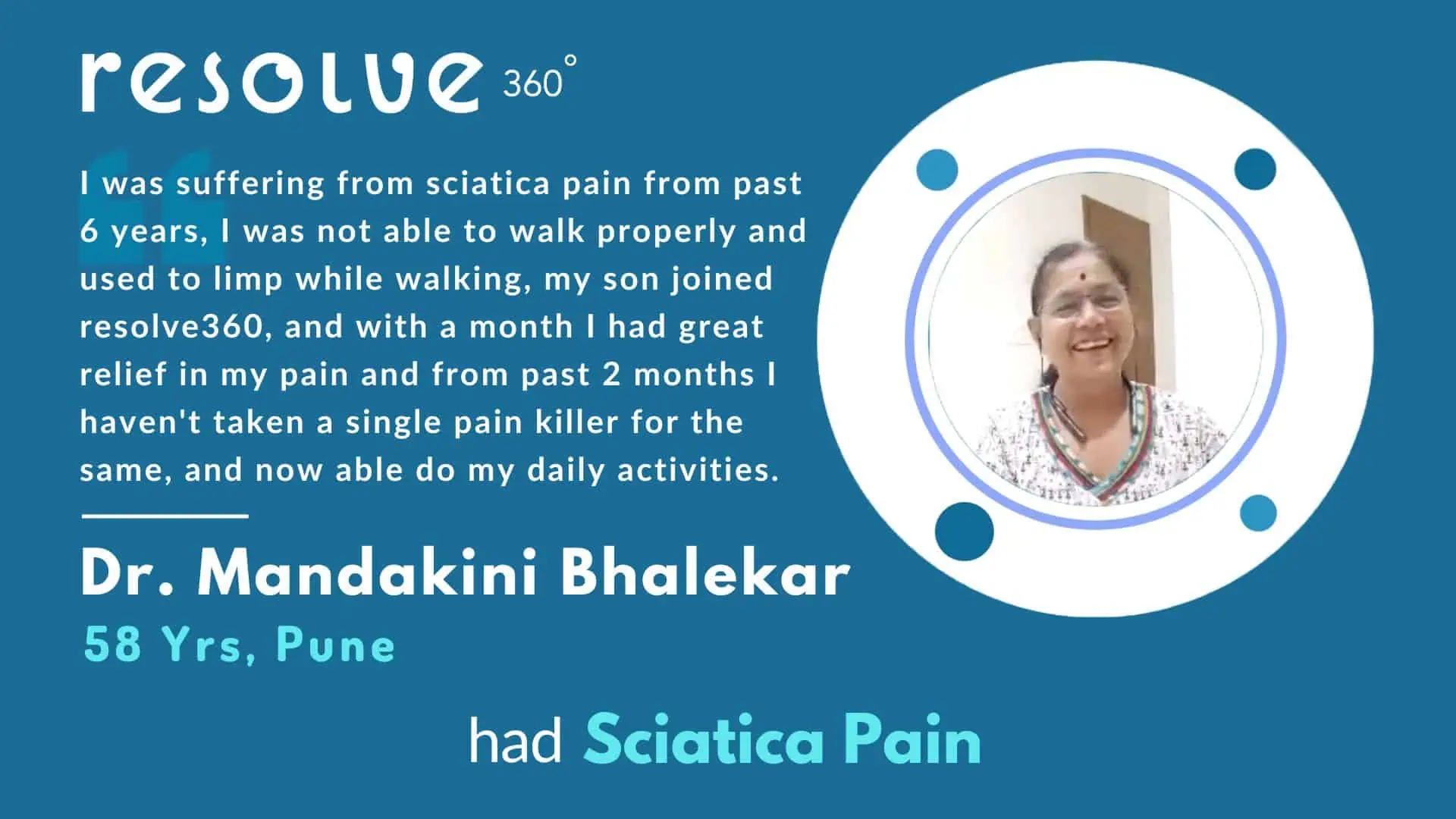
Best therapy sessions that too at home and timings are very flexible. I had a issue in my neck and lower back since almost 4 to 5 years, taken so many treatments and physio sessions. But all gave a temporary relief. Then my friend referred me this Resolve 360 in 2020, in starting i was hesitant as everything was online, but after taking almost 10 sessions i got much relief, and now i am almost free of pain. Thanks to the team of Resolve 360.
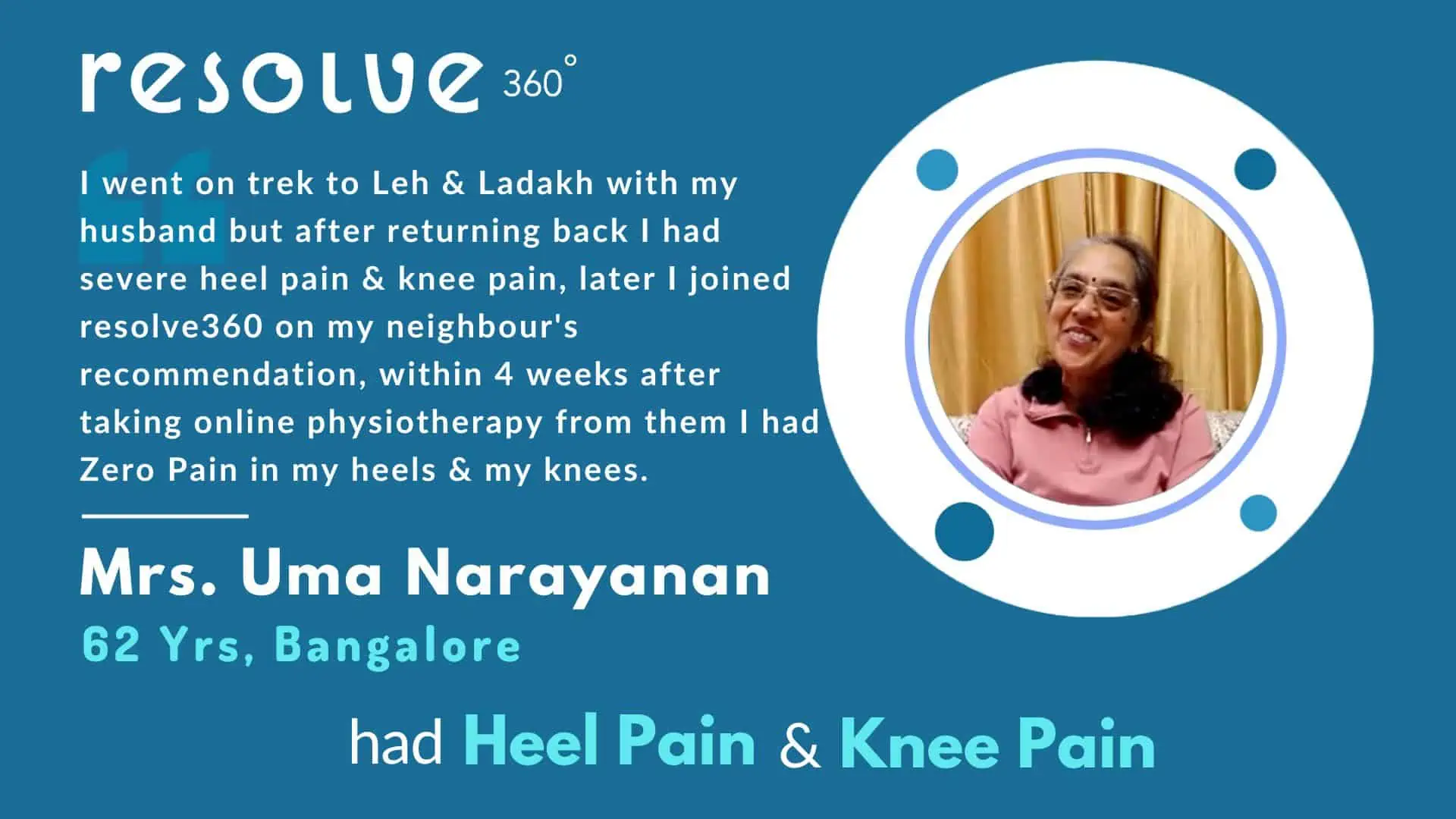
I had online Physiotherpy sessions by Prerana for my heel pain. ( Tendo Achilis Sprain).
Though virtual, it was more interactive.
She was very observant throughout the sessions, correcting me while doing the exercises and was assertive in her outlook.
I found her instructions and methodology very helpful. She is updated in her academic knowledge in the field of Physiotherpy. She clarified my doubts about the role of Laser and Ultrasound treatment quoting evidence based data. With my personal experience I agree with her opinion that these are more of placebo effect.
Physiotherpy though not a miracle treatment, is a compelling necessity to most of the musculoskeletal and neurological illnesses. It needs to be accepted as healthy way to live.
From being a couch potato with poor cardio respiratory system to reaching pre-athlete levels of fitness in a span of 3 months, my journey with Resolve360 and Dr.David (Physiotherapist) has been anything but magical!
About 3 to 4 months ago, my blood report showed very high bad cholesterol levels, I was low on stamina and had frequent breathing issues. My GP prescribed me cholesterol meds for a month but I felt that alone wouldn’t get me back in shape because I needed a major lifestyle overhaul.
Dr.David educated me about my condition in detail and where it could lead me to if I don’t take action in the long run. He put me on a balanced workout regime being easy with cardio workouts in the initial days and gradually upgraded it observing me closely. He also advises me on dietary choices and follows up frequently. During the initial days, my ears used to get blocked within 5 wall squats and I stop right away but now I do over 20 in one shot and hardly feel a thing. I used to lose balance and fall off over my face within 6 push-ups or 20 seconds of plank and now I do about 24 push-ups in one shot. My heart rate used to raise above 150 bpm doing jumping jacks or other cardio workout within 20-30 seconds. You won’t believe I don’t do any of these cardio workouts without additional weights on my feet these days and my heart rate and recovery are as steady as they could get. I couldn’t run for over 2 min without stopping and gasping and now I cover about 4.6 km in 30 min and follow-up with a 20 min walk. Not convinced yet? My VO2 Max (I use an Apple Watch to measure this stat) was just about 33 while I started with Resolve360 and David. That reflects a very poor cardio respiratory fitness for a 34 year old. It’s 43.5 today ! Easily above average. Please read upon about VO2 Max and how it directly relates to cardio respiratory fitness so you get an accurate picture about my monumental progress in the last 3 months. I’ve been trying to get into a regular physical workout and balanced diet discipline since my 20s but I’d never been so motivated as I’m now. Give these guys a try. After all, the best investment you could ever make is on your health !
We contacted resolve360 for our child speech issue and I must say Resolve 360 team and Apoorva doing a wonderful job.
Our speech therapist Jaslia from Resolve360 is having a excellent knowledge and it helps our child a lot. Jaslia understand child psychology very well. Due to her efforts, we are seeing tremendous improvements in our child. She has a strong dedication towards her work and her nature towards kids makes her a very special one. She has given us enough confidence, due to her efforts and excellent service, we are seeing good improvements for my child speech & communication skills.
I would highly recommend Jaslia & Resolve360 team for their excellent work. God bless you!!