How long should you exercise after knee replacement?
How long should you exercise after knee replacement?
How long should you exercise after knee replacement?
Reviewed & Verified by Dr Nidhi
August 16, 2026 5:18 am
[kkratings]
Table of Contents
How long should you exercise after knee replacement?
Most people need to follow a structured exercise plan for at least 12 months after knee replacement surgery. The first 6 weeks focus on reducing swelling and regaining basic movement. Weeks 6–12 focus on building strength. From month 3 to 12, the goal is returning to normal daily activities and improving long-term joint health. Exercise for a stiff knee after surgery is not optional — it directly determines how well your new knee works. Patients who complete consistent post knee replacement exercises with guidance from physical therapy recover faster and with less pain.
Why Exercise After Knee Replacement Actually Matters
Getting a knee replacement is a major step. But here’s something a lot of people don’t fully realize until after surgery: the surgery itself only replaces the damaged joint. Your muscles, tendons, and the tissue around that joint still need to learn how to work with the new hardware. That’s where exercise comes in.
When you skip or rush through post knee replacement exercises, the knee can become stiff, weak, or prone to complications. On the other hand, patients who follow a proper exercise plan — especially one guided by qualified physical therapy — regain function much faster and report higher satisfaction with their results.
So if you’ve been wondering “how long do I really need to keep doing these exercises?” — the answer is: longer than you might think, but totally worth it.
1
Week 1–2: Hospital to Home — Getting Moving
You'll start doing gentle exercises within 24 hours of surgery. These include ankle pumps, straight leg raises, and light walking with support. The goal right now is to prevent blood clots, reduce swelling, and get your knee to bend to at least 90 degrees. This phase of exercise for stiff knee after surgery is critical — don't skip it even if it feels uncomfortable.
2
Week 3–6: Building Range of Motion
This is when physical therapy after knee replacement really kicks in. Your therapist will guide you through seated knee bends, heel slides, and stationary cycling. The aim is to get your knee flexion to 110–120 degrees. Swelling starts to reduce noticeably, and you may be walking more independently. Consistency here is everything.
3
Week 6–12: Strengthening Your Muscles
Now you're moving into more active strengthening exercises. Short-arc quads, mini squats, step-ups, and resistance band work are a common part of this stage of physical therapy for knee replacement. Your new joint is more stable, and your focus shifts from just bending the knee to actually using it with power and control.
4
Month 3–6: Returning to Daily Life
By month three, most patients can walk without a cane, climb stairs, and even do light household chores. Post knee replacement exercises continue, but they start to resemble normal fitness routines — walking programs, light cycling, water aerobics. This phase helps you regain confidence in your knee.
5
Month 6–12: Long-Term Strengthening & Maintenance
Don't stop exercising just because you feel "fine." The knee replacement implant needs continued muscle support to function well for 15–20 years. At this stage, knee replacement physical therapy shifts to maintenance — keeping the muscles strong, maintaining flexibility, and preventing future problems. Many patients continue some form of guided exercise beyond 12 months.
💡 Key Takeaway:
The minimum recommended exercise period after knee replacement is
12 months.
Most orthopedic surgeons and physical therapists recommend some form of ongoing movement and strengthening indefinitely to protect the implant and your overall joint health.
Best Exercises for Stiff Knee After Surgery
A stiff knee is one of the most common frustrations after knee replacement. It happens when scar tissue builds up or when the muscles around the joint tighten from lack of movement. The good news is that with the right exercise for stiff knee after surgery, most people can restore full or near-full range of motion.
Here are the most effective exercises recommended in knee replacement physical therapy programs for stiffness:
🦵
Heel Slides
Lie flat and slowly slide your heel toward your buttocks. Hold for 5 seconds, then slide back. This gently stretches the knee and fights post-surgical stiffness.
🚴
Stationary Bike
Low-impact cycling is one of the best post knee replacement exercises for stiffness. Start with zero resistance and work up gradually as advised by your PT.
🪑
Seated Knee Extensions
Sit in a chair and slowly straighten your leg, hold for 3–5 seconds, then lower. This targets the quadriceps — the key muscle for knee stability.
🌊
Water Aerobics / Pool Walking
Exercising in water reduces joint load by up to 50%, making it perfect for patients who find land-based exercise for stiff knee after surgery too painful at first.
🧘
Gentle Stretching
Calf stretches, hamstring stretches, and hip flexor stretches all help reduce tension around the knee joint and improve overall range of motion after replacement.
🚶
Walking Programs
A structured walking program — starting with 10–15 minutes and building up slowly — remains one of the most effective and underrated post knee replacement exercises.
⚠ Important: If you notice sudden sharp pain, significant swelling, warmth, or redness in your knee while doing any of these exercises, stop immediately and consult your doctor or physical therapist. Pain that worsens over time is not a normal part of recovery.
Why So Many Patients Are Choosing Online Physical Therapy
Traditional clinic-based physical therapy has been the go-to for decades. But a growing number of knee replacement patients across the US are discovering that virtual physical therapyis not only more convenient — it’s just as effective, if not more so, for many people.
Think about it: after a major surgery, the last thing you want to do is drive 30 minutes to a clinic three times a week, find parking, and wait in a lobby. With online physical therapy through Resolve 360, your therapist comes to you — through a secure video call, from the comfort of your living room.
How Resolve 360’s Virtual PT Works
Resolve 360 is a 100% online physical therapy platform. There is no physical clinic — all sessions happen via the Resolve 360 app or web platform. Here’s how it works for knee replacement patients:
✓
Initial Assessment from Home
Your licensed physical therapist conducts a full evaluation via video call — assessing your range of motion, strength, gait, and pain levels to create a personalized recovery plan.
✓
Customized Exercise Programs
Your therapist builds an exercise plan that matches exactly where you are in your recovery. Whether you're in week 2 or month 8, every session targets your specific needs.
✓
Real-Time Guidance & Corrections
Unlike videos on YouTube, Resolve 360's sessions are live and interactive. Your therapist watches you perform each exercise and provides real-time corrections — just like being in a clinic.
✓
Progress Tracking
The app tracks your range of motion, strength gains, and exercise completion so both you and your therapist can see your recovery progress over time.
🇺🇸 No Clinic. No Commute. Just Recovery.
Resolve 360 serves patients across the United States entirely online. Whether you're in a rural area with no nearby PT clinic, or you simply can't drive yet after surgery,
Resolve 360 brings qualified, licensed physical therapists directly to your screen.
Signs You May Need to Continue Physical Therapy Longer
Every patient is different, and some people need physical therapy for knee replacement for longer than the typical 12 months. Here are clear signs that you should continue or re-engage with physical therapy after knee replacement:
Your knee still feels stiff in the morning and takes more than 15 minutes to loosen up. You’re unable to bend your knee past 110–115 degrees at the 3-month mark. You’re limping or compensating with your hip or opposite leg. You’re afraid to walk on uneven surfaces or stairs. You’ve noticed weakness returning after you stopped exercising. Pain has been returning even for simple tasks like rising from a chair.
If any of these sound familiar, it doesn’t mean something is “wrong” with your replacement — it usually just means your muscles and tissues need more structured attention. A few additional weeks or months of guided exercise for stiff knee after surgery can make a dramatic difference.
The Bottom Line
Knee replacement is one of the most successful surgeries in modern medicine — but only when it’s paired with consistent, guided rehabilitation. The question isn’t really “how long do I have to do this?” — it’s “how can I make the most of my recovery so I can get back to doing the things I love?”
Exercise for stiff knee after surgery, done correctly and consistently, is the single biggest factor in how well your new knee performs. Most patients benefit from structured physical therapy for at least 12 months, with some form of maintenance exercise continuing well beyond that.
And if getting to a clinic is difficult, you don’t have to let that be a barrier anymore. With online physical therapy through Resolve 360, you get access to experienced, licensed therapists who will guide your entire recovery — right from your phone or laptop. Your new knee deserves the best possible start. Make it count.
The structured, intensive rehabilitation phase typically wraps up between 6 to 12 months. However, to protect your implant and maintain strength long-term, most orthopedic specialists recommend some form of regular low-impact exercise — like walking, cycling, or water aerobics — for life. The good news is that it becomes less of a “medical exercise” routine and more just a healthy lifestyle.
Yes, some stiffness is completely normal up to 6 months after surgery, especially in the morning or after sitting for long periods. This is often related to scar tissue formation. Consistent exercise for stiff knee after surgery — particularly heel slides, gentle cycling, and range-of-motion work — is the best way to reduce this. If stiffness is severe or getting worse, consult your physical therapist.
In the early weeks, most physical therapy programs recommend doing exercises 2–3 times per day in short sessions. As you progress, this typically shifts to once a day, then several times per week. Your therapist will guide the frequency based on how your knee is responding. Quality and consistency matter more than duration.
Absolutely. Multiple clinical studies have shown that virtual physical therapy produces outcomes comparable to in-person care for knee replacement patients. Platforms like Resolve 360 offer live, one-on-one sessions with licensed physical therapists who can assess your movement, guide your exercises in real time, and adjust your program as you progress — all from home.
Skipping or cutting short your physical therapy for knee replacement significantly increases the risk of chronic stiffness, weakness, scar tissue buildup (called arthrofibrosis), long-term limping, and reduced overall function of the implant. In some cases, patients who didn’t complete their PT need a procedure called manipulation under anesthesia to restore range of motion. The exercises are not optional — they’re a core part of the surgery’s success.
Ready to Recover from Knee Surgery —
the Right Way, From Home?
Join 50,000+ patients who trusted Resolve 360 for expert online rehabilitation.
Personalized plans, live sessions, certified physios — and your first session is completely free.
She has persuaded her bachelor’s from SGT University, Gurugram, she has done her internship at Dr. Ram Manohar Lohia Hospital, and persuade her Master in Physiotherapy from Chaudhary Charan Singh University, Meerut. She has previously worked with Orthocure clinic, Dr.Nasir physiotherapy rehabilitation, Quantum physiotherapy, and wellness center.
She has persuaded her bachelor’s from SGT University, Gurugram, she has done her internship at Dr. Ram Manohar Lohia Hospital, and persuade her Master in Physiotherapy from Chaudhary Charan Singh University, Meerut. She has previously worked with Orthocure clinic, Dr.Nasir physiotherapy rehabilitation, Quantum physiotherapy, and wellness center.
I have been taking sessions from March without a break. It has been a boon for my physical fitness. My issues with my fitness especially knee ligaments have been effectively taken care of and I am able to continue with active tennis daily thanks to resolve360 and Dr. David
Mr Keyur Dalwadi
Speech Therapy for his Kid
We contacted resolve360 for our child speech issue and I must say Resolve 360 team and Apoorva doing a wonderful job.
Our speech therapist Jaslia from Resolve360 is having a excellent knowledge.... Read More
Mr Ram Kumar
Physical Fitness
From being a couch potato with poor cardio respiratory system to reaching pre-athlete levels of fitness in a span of 3 months, my journey with Resolve360 and Dr.David (Physiotherapist) has been anything but magical!..... Read More
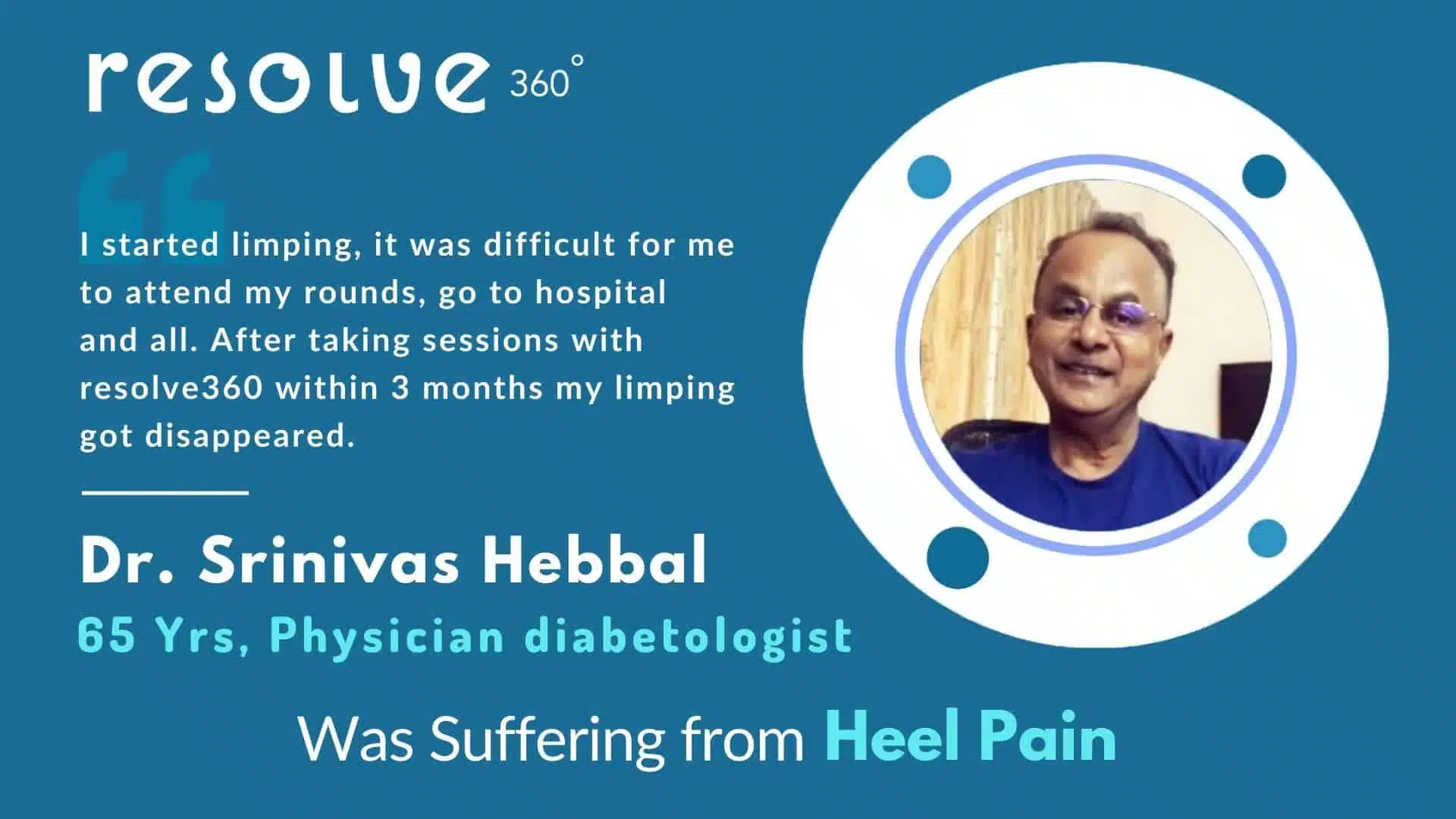
Dr Shrinivas H
Rehab for Heel Pain
I had online Physiotherapy sessions by Prerana for my heel pain. ( Tendo Achilis Sprain).
Though virtual, it was more interactive.
She was very observant throughout the sessions, correcting me while doing the exercises..... Read More
Mr Narayan Vyas
COVID19 Rehab
One of the best app available for therapy sessions online. I was covid positive, and one more my friend recommended this app, trust me, it was the best decision I have ever taken..... Read More
Ms Shilpi B
Rehab for Ligament Injury
A friend introduced me to Resolve 360 so that I could treat a ligament injury that was hindering my day to day activities. It was a bad phase! This platform is not only a.... Read More
Ms Uma Narayanan
Rehab for Back Pain
Let the year 2021 bring laughter, joy and happiness and good health. It already has, in mine and my husband Narayans life. Yes we are now freely moving around doing..... Read More
Mr Nikhil Shrivastava
COVID19 Rehab
My father’s case was worse case of covid he had severe lung damage and was in hospital for almost 40 days, My mentor here provided really great guidance and help; sessions helped so much in recovery...Read More
Ms Srishti Gupta
Rehab for Back Pain
Hello everyone
I have been regularly taking sessions from Resolve360 (from Dr Apoorva) since January 2020. I have been suffering from upper and lower back pain from last 10 years....Read More
Ms Christy J
Post Natal Care
By the advice of my gynaecologist, I found this place. I thank doctor Dr Aporva for supported me and encouraged me well even before my sessions begin. Doctor Prerna who dealt me...Read More
Ms Garima Gupta
Rehab for Neck & Back Pain
Best therapy sessions that too at home and timings are very flexible. I had a issue in my neck and lower back since almost 4 to 5 years, taken so many treatments...Read More
Ms Shubhra Jain
Prenatal Care
I took prenatal care program from Resolve 360. Dr. Preyrna was assigned to me and she has done commendable job. I did prenatal exercises under her supervision, she designed...Read More
Ms Shruti Gupta
Rehab for Scapula Dyskinesia
Resolve360 is great platform for online physiotherapy.
I was suffering from scapula dyskinesia and had lot of pain in right shoulder movement.
I was introduced...Read More
R HARISHANKAR
COVID19 Rehab
The therapy sessions were very helpful in regaining heart and lung fitness after recovering from covid. The trainers were friendly, knowledgeable and they provided a customised program depending on my fitness level and health condition.
Mr Rohit Musaddi
Rehab for Knee Pain
I have been taking sessions from March without a break. It has been a boon for my physical fitness. My issues with my fitness especially knee ligaments have been effectively taken care of and I am able to continue with active tennis daily thanks to resolve360 and Dr. David
Mr Keyur Dalwadi
Speech Therapy for his Kid
We contacted resolve360 for our child speech issue and I must say Resolve 360 team and Apoorva doing a wonderful job.
Our speech therapist Jaslia from Resolve360 is having a excellent knowledge.... Read More
Mr Ram Kumar
Physical Fitness
From being a couch potato with poor cardio respiratory system to reaching pre-athlete levels of fitness in a span of 3 months, my journey with Resolve360 and Dr.David (Physiotherapist) has been anything but magical!..... Read More
Dr Shrinivas H
Rehab for Heel Pain
I had online Physiotherapy sessions by Prerana for my heel pain. ( Tendo Achilis Sprain).
Though virtual, it was more interactive.
She was very observant throughout the sessions, correcting me while doing the exercises..... Read More
Mr Narayan Vyas
COVID19 Rehab
One of the best app available for therapy sessions online. I was covid positive, and one more my friend recommended this app, trust me, it was the best decision I have ever taken..... Read More
Ms Shilpi B
Rehab for Ligament Injury
A friend introduced me to Resolve 360 so that I could treat a ligament injury that was hindering my day to day activities. It was a bad phase! This platform is not only a.... Read More
Ms Uma Narayanan
Rehab for Back Pain
Let the year 2021 bring laughter, joy and happiness and good health. It already has, in mine and my husband Narayans life. Yes we are now freely moving around doing..... Read More
Mr Nikhil Shrivastava
COVID19 Rehab
My father’s case was worse case of covid he had severe lung damage and was in hospital for almost 40 days, My mentor here provided really great guidance and help; sessions helped so much in recovery...Read More
Ms Srishti Gupta
Rehab for Back Pain
Hello everyone
I have been regularly taking sessions from Resolve360 (from Dr Apoorva) since January 2020. I have been suffering from upper and lower back pain from last 10 years....Read More
Ms Christy J
Post Natal Care
By the advice of my gynaecologist, I found this place. I thank doctor Dr Aporva for supported me and encouraged me well even before my sessions begin. Doctor Prerna who dealt me...Read More
Ms Garima Gupta
Rehab for Neck & Back Pain
Best therapy sessions that too at home and timings are very flexible. I had a issue in my neck and lower back since almost 4 to 5 years, taken so many treatments...Read More
Ms Shubhra Jain
Prenatal Care
I took prenatal care program from Resolve 360. Dr. Preyrna was assigned to me and she has done commendable job. I did prenatal exercises under her supervision, she designed...Read More
Ms Shruti Gupta
Rehab for Scapula Dyskinesia
Resolve360 is great platform for online physiotherapy.
I was suffering from scapula dyskinesia and had lot of pain in right shoulder movement.
I was introduced...Read More
R HARISHANKAR
COVID19 Rehab
The therapy sessions were very helpful in regaining heart and lung fitness after recovering from covid. The trainers were friendly, knowledgeable and they provided a customised program depending on my fitness level and health condition.
If you would like to know more about any of the health conditions, please fill up the form below and talk to Doctors on Resolve360 directly by asking a question.
We are your doctor’s first choice and trusted by 50,000+ patients.
get a call in 15 minutes
We are your doctor’s first choice and trusted by 50,000+ patients.
Get a Call in 15 Minutes
We are your doctor’s first choice and trusted by 50,000+ patients.
Get a Call in 15 Minutes
We are your doctor’s first choice and trusted by 50,000+ patients.