In order to do L4-L5 Disc Bulge Treatment Without Surgery, we first need to understand what the L4-L5 Disc Bulge actually is.
Our spine has bones known as vertebrae stacked over each other with intervertebral discs in between them.
The L4-L5 Disc refers to the intervertebral disc located in between the fourth lumbar (L4) and 5th lumbar (L5) vertebrae in the lower back of spine.
A bulging L4-L5 disc simply means that the intervertebral disc in between the 4th lumbar and 5th lumbar has been stretched or pushed outward.
Contrary to popular myth, L4-L5 Disc Bulge Treatment Without Surgery is entirely possible.
What is L4-L5 Disc Bulge?
The L4-L5 Disc bulge occurs due to the extension of the intervertebral disc outward beyond its boundary.
The intervertebral discs are soft, gel-like fibrocartilaginous cushions that act as shock absorbers, keeping the vertebrae from grinding against each other, and maintain space in order for the nerves to exit properly.
When the tough outer layer of this disc, known as annulus fibrosus, weakens and extends outward beyond its normal periphery, it causes a bulging disc.
Is L4-L5 Disc Bulge Treatment Without Surgery Possible?
Yes. Treatment of L4-L5 Disc Bulge Non-Surgically is entirely possible especially when it has been diagnosed at mild or moderate levels with no major neurological problems.
What matters most is the severity of nerve compression and presence of neurological deficits.
Conservative care is tried primarily and and if nerve involvement is absent then non-surgical care is often more appropriate
What Can Be The Symptoms of L4-L5 Disc Bulge?
The symptoms of L4-L5 Disc Bulge involve the following:
Dull or sharp lower back pain
Pain that worsens with movements like sitting, bending, or coughing
Muscle weakness, for example, difficulty in lifting the foot
Numbness, tingling or burning sensations in leg distribution of the affected Nerve,i.e., often L5 Nerve
Sciatica
A severe symptom of L4-L5 Disc Bulge can include nerve compression which can lead to leg weakness and instability (foot drop) and loss of bowel/bladder control.
Identification of these symptoms can help your doctor do proper diagnosis and treatment.
Causes of L4-L5 Disc Bulge
L4-L5 disc bulge occurs due to mechanical stress or the structural changes in the disc.
The main factors causing L4-L5 disc bulge are:
Degeneration/Ageing
With growing age, the discs lose water content and elasticity present in them. This makes them weak and prone to bulging.
Injury or Trauma
Acute events like falling, sports injuries, or even car accidents can damage the structure of the disc leading to a bulging disc.
Genetic Predisposition
Genes inherited can also be a cause of bulging disc in some cases.
Mechanical and Lifestyle Factors
Many mechanical and lifestyle factors are also involved in causing L4-L5 disc bulge. These factors can be:
Poor posture
Inactive lifestyle
Obesity
Keeping an eye out for these factors and noticing the symptoms are both crucial for proper diagnosis and treatment of L4-L5 Disc Bulge.
Diagnosis of L4-L5 Disc Bulge
Recent studies and global physiotherapy guidelines have reshaped how this condition is managed.
1. Early Physiotherapy Prevents Chronic Nerve Compression
A 2025 review in the Journal of Orthopaedic & Sports Physiotherapy found that patients who started physiotherapy within 3 months of symptoms had 70% faster recovery compared to those who delayed treatment.
2. Posture-Centric Training Shows Long-Term Relief
A clinical trial (Physiotherapy Research International, 2025) confirmed that posture correction combined with neck-strengthening exercises reduces recurrence by over 60%.
3. Digital Physiotherapy Matches In-Person Outcomes
A global tele-rehabilitation study (2024–2025) showed online physiotherapy for cervical spondylosis offers similar pain relief and function improvement as clinic-based sessions — especially with live guidance.
Soft-tissue release therapy before stretching was found to improve neck range of motion and reduce muscle tightness more effectively.
5. Ergonomic Training Prevents Relapse
Regular ergonomic coaching — learning correct laptop and phone use — reduces recurrence and chronic strain, now an essential part of 2025 physiotherapy programs.
10-Minute Daily Physiotherapy Routine for Cervical Spondylosis
Just 10 minutes daily can help you maintain a pain-free neck. This routine combines flexibility, strength, and relaxation — key pillars of cervical spondylosis physiotherapy.
Morning Routine (4 Minutes)
Neck Rotation (1 Minute) Turn your head slowly from side to side, keeping shoulders relaxed. Benefits: Improves flexibility and joint lubrication.
Neck Side Bend (1 Minute) Tilt your head toward your shoulder until a light stretch is felt on the opposite side. Benefits: Relieves lateral muscle tension.
Chin Tuck (1 Minute) Sit or stand tall. Gently pull your chin backward (like making a double chin). Hold for 5 seconds and repeat 10 times. Benefits: Strengthens deep neck muscles and corrects posture.
Shoulder Rolls (1 Minute) Roll shoulders backward and forward in slow circles. Benefits: Reduces upper back stiffness and tension.
Midday Routine (3 Minutes)
Seated Posture Reset (1 Minute) Sit tall, shoulders relaxed, chin slightly tucked. Check every hour if you’re slouching. Benefits: Reduces compression on cervical discs.
Scapular Squeeze (1 Minute) Pull shoulder blades together and hold for 5 seconds. Repeat 10 times. Benefits: Improves shoulder stability and posture.
Neck Isometrics (1 Minute) Press your hand gently against your forehead or side of your head while resisting the movement. Benefits: Builds neck strength safely.
Evening Routine (3 Minutes)
Chest Expansion (1 Minute) Take deep breaths, expanding your chest and straightening your back. Benefits: Improves posture and oxygen flow.
Upper Trapezius Stretch (1 Minute) Gently pull your head to the side with one hand. Hold 10–15 seconds. Benefits: Relieves tension in shoulder and neck.
Physiotherapy Treatment Approach for Cervical Spondylosis
Cervical spondylosis physiotherapycan now be done comfortably from home through online sessions, with expert guidance every step of the way. The treatment is usually divided into three stages:
Stage 1: Assessment & Education
The first session focuses on understanding your neck health and habits:
Posture analysis and spine mobility check via video
Review of daily activities, work setup, and sleep position
Personalized neck exercise plan tailored to your needs
Guidance on do’s and don’ts for cervical spine care
Stage 2: Pain Relief & Mobility Training
Once the assessment is complete, the focus shifts to reducing pain and stiffness:
After pain improves, the goal is to build strength and prevent future problems:
Neck, shoulder, and core strengthening exercises
Shoulder stability and posture support
Relaxation and deep-breathing techniques
Long-term home exercise plan for daily maintenance
Every session is personalized and monitored online by a physiotherapist, ensuring safe, effective, and consistent care without leaving home.
Real-Life Success Story: Online Physiotherapy That Worked
Patient: Neha Sharma, 36, Bangalore Condition: Chronic neck pain from long hours of laptop work
Neha had been struggling with persistent neck stiffness and headaches for over six months. She joined an online cervical spondylosis physiotherapy program that focused on posture correction, neck exercises, and ergonomic guidance.
Within 6 weeks, she experienced remarkable improvements:
Pain reduced by 70%
Headaches almost disappeared
Full neck movement restored, allowing her to work comfortably
I was surprised how effective the online sessions were. The therapist watched every movement, corrected my posture, and gave daily motivation — all from home! – Neha Sharma
This story shows how consistent online cervical spondylosis physiotherapy can help relieve pain, improve flexibility, and restore daily function without leaving home.
2025 Global Physiotherapy Recommendations for Cervical Spondylosis
Leading physiotherapy organizations worldwide now emphasize a multimodal approach to manage cervical spondylosis effectively. This combines exercises, posture correction, education, and guided therapy to reduce pain, improve mobility, and prevent further degeneration.
Key Recommendations:
Exercise Therapy: Gentle stretching and targeted neck and shoulder strength training to maintain flexibility and support the cervical spine.
Posture Correction: Ergonomic adjustments for sitting, sleeping, and workstations to reduce stress on neck joints.
Patient Education: Guidance on safe movements, self-care, and activity modifications to prevent flare-ups.
Manual Therapy: Myofascial release and joint mobilization to reduce stiffness and improve neck range of motion.
Digital Follow-up: Online physiotherapy check-ins, exercise monitoring, and progress tracking for consistent care.
These recommendations reflect 2025 clinical evidence and highlight that combining exercises, posture management, and ongoing guidance—either in-person or online—offers the best long-term outcomes for cervical spondylosis patients
Why Choose Resolve360 for Cervical Spondylosis Physiotherapy
Choosing the right physiotherapy program is essential for effective and lasting relief from cervical spondylosis. Resolve360 offers a comprehensive, evidence-based online physiotherapy program designed for patients worldwide.
Expert Spine Physiotherapists: All sessions are led by certified physiotherapists specializing in cervical spine rehabilitation, ensuring safe and effective care.
100% Online Convenience: Receive treatment from the comfort of your home — no travel, no waiting rooms. Available across India, the UK, and the USA.
Personalized Recovery Plan: Each exercise, stretch, and posture correction is tailored to your pain level, daily routine, and lifestyle.
Evidence-Based Care: All treatment methods follow the latest 2025 global physiotherapy guidelines and spine care research.
Consistent Support: Regular follow-ups, progress tracking, and posture re-evaluations ensure steady improvement and long-term recovery.
When to Seek Immediate Help
It’s important to pay attention to warning signs that may indicate nerve involvement or a more serious issue. Contact your physiotherapist or doctor immediately if you experience:
Severe pain radiating down your arms
Weakness, numbness, or loss of hand grip
Persistent dizziness or tingling in the arms or hands
Early intervention can prevent further complications and help you recover faster.
Start Your Recovery Today
Don’t let neck pain hold you back from living your best life. With consistent physiotherapy for cervical spondylosis, you can:
Restore neck and shoulder movement
Reduce stiffness and discomfort
Improve posture and confidence
Take the first step towards a pain-free neck. Book your online consultation today to receive a personalized posture plan, guided exercises, and one-on-one video sessions, all from the comfort of your home.
Yes, physiotherapy is one of the most effective and natural treatments for cervical spondylosis. It helps reduce neck pain, stiffness, and discomfort by improving posture, strengthening neck and shoulder muscles, and restoring flexibility. Regular guided physiotherapy sessions prevent nerve compression and long-term degeneration, promoting pain-free neck movement.
The best treatment combines physiotherapy, posture correction, ergonomic adjustments, and neck exercises. Early intervention through professional physiotherapy reduces pain, increases neck mobility, and prevents future degeneration — providing safe, non-surgical, and long-lasting relief.
The most effective exercises for cervical spondylosis include:
Chin tucks – to correct forward head posture
Neck rotations – to improve flexibility
Scapular retractions & shoulder shrugs – to strengthen upper back and neck muscles These gentle exercises reduce stiffness, relieve pain, and enhance posture when performed under physiotherapist guidance.
In children, treatment focuses on posture correction, light physiotherapy, and mobility exercises. Early physiotherapy ensures healthy neck development, reduces strain from poor posture, and prevents long-term spinal problems — all without relying on heavy medication.
Severe or worsening neck pain, numbness, tingling, weakness in the arms, headaches, dizziness, or loss of grip strength are serious symptoms. These may indicate nerve compression and require immediate evaluation by a physiotherapist or spine specialist.
Yes. Physical therapy improves neck strength, flexibility, and posture. It relieves pain, reduces stiffness, and helps prevent further spinal wear and tear. Regular sessions support long-term management and reduce dependence on painkillers or surgery.
A gentle therapeutic massage can relieve muscle tension and improve blood circulation. However, it’s most effective when combined with neck exercises and physiotherapy for cervical spondylosis. This integrated approach helps maintain flexibility and reduces chronic stiffness.
Most patients experience noticeable relief within 4–8 weeks of consistent physiotherapy. The recovery time depends on the severity of the condition, regularity of sessions, and adherence to home exercises and posture corrections.
Yes. Cervical spondylosis can cause tension headaches due to neck stiffness and nerve irritation. Targeted physiotherapy, stretching, and posture correction can significantly reduce headache frequency and improve overall neck comfort.
Absolutely. Online physiotherapy offers guided neck exercises, posture correction, and real-time feedback from experts. With professional supervision, patients can safely perform home-based exercises, relieve pain, and improve neck mobility effectively.
Dr. Nidhi Kumari
She has persuaded her bachelor’s from SGT University, Gurugram, she has done her internship at Dr. Ram Manohar Lohia Hospital, and persuade her Master in Physiotherapy from Chaudhary Charan Singh University, Meerut. She has previously worked with Orthocure clinic, Dr.Nasir physiotherapy rehabilitation, Quantum physiotherapy, and wellness center.
She has persuaded her bachelor’s from SGT University, Gurugram, she has done her internship at Dr. Ram Manohar Lohia Hospital, and persuade her Master in Physiotherapy from Chaudhary Charan Singh University, Meerut. She has previously worked with Orthocure clinic, Dr.Nasir physiotherapy rehabilitation, Quantum physiotherapy, and wellness center.
I have been taking sessions from March without a break. It has been a boon for my physical fitness. My issues with my fitness especially knee ligaments have been effectively taken care of and I am able to continue with active tennis daily thanks to resolve360 and Dr. David
Mr Keyur Dalwadi
Speech Therapy for his Kid
We contacted resolve360 for our child speech issue and I must say Resolve 360 team and Apoorva doing a wonderful job.
Our speech therapist Jaslia from Resolve360 is having a excellent knowledge.... Read More
Mr Ram Kumar
Physical Fitness
From being a couch potato with poor cardio respiratory system to reaching pre-athlete levels of fitness in a span of 3 months, my journey with Resolve360 and Dr.David (Physiotherapist) has been anything but magical!..... Read More
Dr Shrinivas H
Rehab for Heel Pain
I had online Physiotherapy sessions by Prerana for my heel pain. ( Tendo Achilis Sprain).
Though virtual, it was more interactive.
She was very observant throughout the sessions, correcting me while doing the exercises..... Read More
Mr Narayan Vyas
COVID19 Rehab
One of the best app available for therapy sessions online. I was covid positive, and one more my friend recommended this app, trust me, it was the best decision I have ever taken..... Read More
Ms Shilpi B
Rehab for Ligament Injury
A friend introduced me to Resolve 360 so that I could treat a ligament injury that was hindering my day to day activities. It was a bad phase! This platform is not only a.... Read More
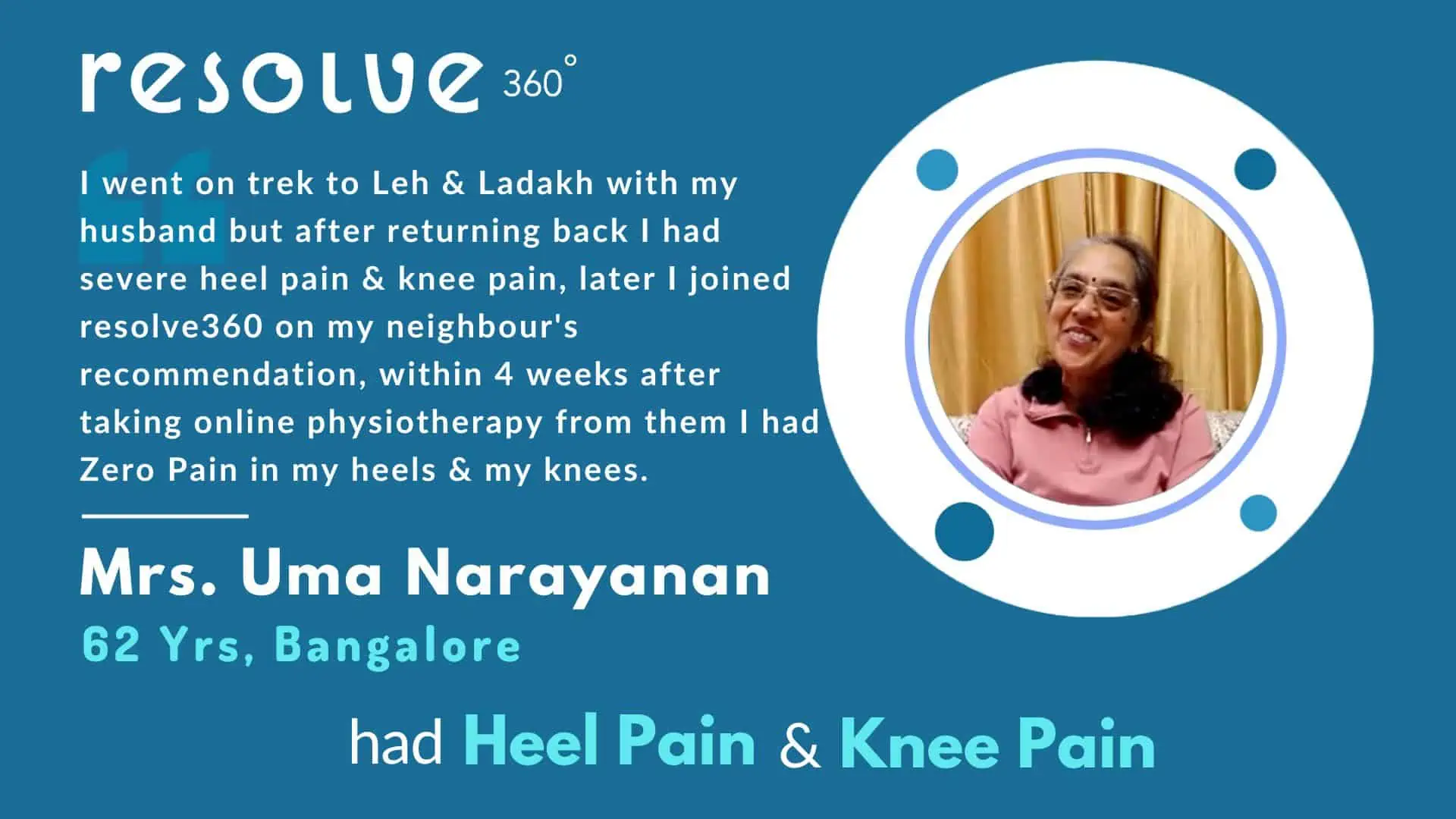
Ms Uma Narayanan
Rehab for Back Pain
Let the year 2021 bring laughter, joy and happiness and good health. It already has, in mine and my husband Narayans life. Yes we are now freely moving around doing..... Read More
Mr Nikhil Shrivastava
COVID19 Rehab
My father’s case was worse case of covid he had severe lung damage and was in hospital for almost 40 days, My mentor here provided really great guidance and help; sessions helped so much in recovery...Read More
Ms Srishti Gupta
Rehab for Back Pain
Hello everyone
I have been regularly taking sessions from Resolve360 (from Dr Apoorva) since January 2020. I have been suffering from upper and lower back pain from last 10 years....Read More
Ms Christy J
Post Natal Care
By the advice of my gynaecologist, I found this place. I thank doctor Dr Aporva for supported me and encouraged me well even before my sessions begin. Doctor Prerna who dealt me...Read More
Ms Garima Gupta
Rehab for Neck & Back Pain
Best therapy sessions that too at home and timings are very flexible. I had a issue in my neck and lower back since almost 4 to 5 years, taken so many treatments...Read More
Ms Shubhra Jain
Prenatal Care
I took prenatal care program from Resolve 360. Dr. Preyrna was assigned to me and she has done commendable job. I did prenatal exercises under her supervision, she designed...Read More
Ms Shruti Gupta
Rehab for Scapula Dyskinesia
Resolve360 is great platform for online physiotherapy.
I was suffering from scapula dyskinesia and had lot of pain in right shoulder movement.
I was introduced...Read More
R HARISHANKAR
COVID19 Rehab
The therapy sessions were very helpful in regaining heart and lung fitness after recovering from covid. The trainers were friendly, knowledgeable and they provided a customised program depending on my fitness level and health condition.
Mr Rohit Musaddi
Rehab for Knee Pain
I have been taking sessions from March without a break. It has been a boon for my physical fitness. My issues with my fitness especially knee ligaments have been effectively taken care of and I am able to continue with active tennis daily thanks to resolve360 and Dr. David
Mr Keyur Dalwadi
Speech Therapy for his Kid
We contacted resolve360 for our child speech issue and I must say Resolve 360 team and Apoorva doing a wonderful job.
Our speech therapist Jaslia from Resolve360 is having a excellent knowledge.... Read More
Mr Ram Kumar
Physical Fitness
From being a couch potato with poor cardio respiratory system to reaching pre-athlete levels of fitness in a span of 3 months, my journey with Resolve360 and Dr.David (Physiotherapist) has been anything but magical!..... Read More
Dr Shrinivas H
Rehab for Heel Pain
I had online Physiotherapy sessions by Prerana for my heel pain. ( Tendo Achilis Sprain).
Though virtual, it was more interactive.
She was very observant throughout the sessions, correcting me while doing the exercises..... Read More
Mr Narayan Vyas
COVID19 Rehab
One of the best app available for therapy sessions online. I was covid positive, and one more my friend recommended this app, trust me, it was the best decision I have ever taken..... Read More
Ms Shilpi B
Rehab for Ligament Injury
A friend introduced me to Resolve 360 so that I could treat a ligament injury that was hindering my day to day activities. It was a bad phase! This platform is not only a.... Read More
Ms Uma Narayanan
Rehab for Back Pain
Let the year 2021 bring laughter, joy and happiness and good health. It already has, in mine and my husband Narayans life. Yes we are now freely moving around doing..... Read More
Mr Nikhil Shrivastava
COVID19 Rehab
My father’s case was worse case of covid he had severe lung damage and was in hospital for almost 40 days, My mentor here provided really great guidance and help; sessions helped so much in recovery...Read More
Ms Srishti Gupta
Rehab for Back Pain
Hello everyone
I have been regularly taking sessions from Resolve360 (from Dr Apoorva) since January 2020. I have been suffering from upper and lower back pain from last 10 years....Read More
Ms Christy J
Post Natal Care
By the advice of my gynaecologist, I found this place. I thank doctor Dr Aporva for supported me and encouraged me well even before my sessions begin. Doctor Prerna who dealt me...Read More
Ms Garima Gupta
Rehab for Neck & Back Pain
Best therapy sessions that too at home and timings are very flexible. I had a issue in my neck and lower back since almost 4 to 5 years, taken so many treatments...Read More
Ms Shubhra Jain
Prenatal Care
I took prenatal care program from Resolve 360. Dr. Preyrna was assigned to me and she has done commendable job. I did prenatal exercises under her supervision, she designed...Read More
Ms Shruti Gupta
Rehab for Scapula Dyskinesia
Resolve360 is great platform for online physiotherapy.
I was suffering from scapula dyskinesia and had lot of pain in right shoulder movement.
I was introduced...Read More
R HARISHANKAR
COVID19 Rehab
The therapy sessions were very helpful in regaining heart and lung fitness after recovering from covid. The trainers were friendly, knowledgeable and they provided a customised program depending on my fitness level and health condition.
If you would like to know more about any of the health conditions, please fill up the form below and talk to Doctors on Resolve360 directly by asking a question.
We are your doctor’s first choice and trusted by 50,000+ patients.
get a call in 15 minutes
We are your doctor’s first choice and trusted by 50,000+ patients.
Get a Call in 15 Minutes
We are your doctor’s first choice and trusted by 50,000+ patients.
Get a Call in 15 Minutes
We are your doctor’s first choice and trusted by 50,000+ patients.